The Inner Citadel: What Hadot Adds (and Who Should Skip It)
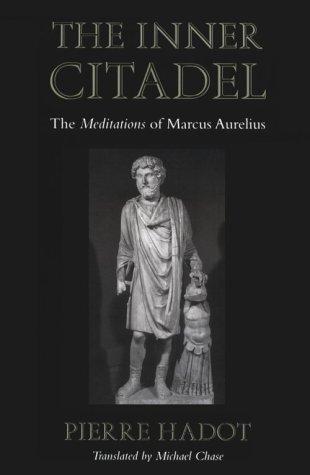
Pierre Hadot’s The Inner Citadel does one thing no other book about Marcus Aurelius manages: it explains why Meditations is so repetitive without treating repetition as a flaw. That single move reframes the entire text.
The argument, compressed: Meditations isn’t a systematic philosophy. It’s spiritual exercises — Marcus writing to himself, over and over, to internalize doctrines he knew intellectually but hadn’t yet made automatic. The repetition isn’t poor editing. It’s the method. You rehearse the same principles until they fire without effort, the way a musician scales until the hand moves without the head.
If you’ve read Meditations once and found it strangely circular — brilliant lines scattered among things he seems to have said four times already — Hadot explains the circularity. That’s most of what you need from this book.
What Hadot Actually Argues
The organizing concept is three disciplines: the discipline of desire (accepting what happens), of action (acting for the common good), and of assent (controlling how you judge events). Hadot argues these map onto the three parts of Stoic philosophy — physics, ethics, logic — and that Marcus returns to them constantly because they represent a complete practice, not a list of tips.
He also recovers the phrase that titles the book. The “inner citadel” is Hadot’s reading of a passage where Marcus describes the ruling faculty — the hegemonikon — as something external events can’t breach unless you hand them the keys. It’s a more precise concept than the vague “you can’t control what happens, only your response” version that floats around Twitter. Marcus isn’t just noting that attitude matters; he’s describing a faculty with a technical function in Stoic physics.
This is scholarship, and Hadot doesn’t apologize for it. There are extended sections on Stoic logic, on how Marcus departs from earlier Stoics, on the Greek philosophical schools Marcus was reading. A chapter compares Marcus’s use of the kathêkon — appropriate action — with Epictetus’s handling of the same concept. It’s rigorous.
The Problem for Non-Academic Readers
The book is translated from French by Michael Chase (Harvard University Press). The translation is good. The prose is still dense.
Hadot writes for readers who have already read Meditations at least once and have some passing familiarity with Hellenistic philosophy. He does not explain Stoicism from scratch. He assumes you know who Chrysippus is, or that you’ll look it up. Opening The Inner Citadel as your first Stoic text is the reading equivalent of starting a tour in a room you haven’t entered yet.
At around 350 pages including notes, it requires a specific kind of patience. The payoff is real, but it arrives gradually, built through careful argument rather than quotable insight.
Who Should Read It
Read The Inner Citadel if:
- You’ve finished Meditations and found yourself wanting more than “Marcus was wise.”
- You bounced off Meditations because the repetition seemed like noise.
- You’ve read the Gregory Hays translation and want to understand what choices Hays made and why. Hadot’s reading illuminates why translators disagree so sharply about certain passages — the philosophical stakes are higher than they look.
- You’re curious about Meditations as a historical object: what Marcus was reading, who he was arguing with, why he wrote in Greek.
The Gregory Hays translation is still the place to start with Meditations itself. Hadot is what you read after.
Who Should Skip It Without Guilt
Most people. That’s not condescension — it’s an accurate description of the book’s audience.
If your interest in Marcus Aurelius is practical — you want the discipline of desire concept without the Greek terminology, something that fits a commute — Hadot is wrong for you. Ryan Holiday’s The Daily Stoic exists for that purpose, and it works on its own terms even if the philosophy is thin. William Irvine’s A Guide to the Good Life is also more accessible and doesn’t pretend otherwise.
If you want a single book on Marcus that’s rigorous and readable, Gregory Hays’s introduction to his own translation covers about thirty pages and captures a surprising portion of Hadot’s argument in compressed form. Read that first.
The One Thing Hadot Changes
Hadot relocates Meditations from the self-help shelf to the philosophy shelf, and then explains why that relocation matters for how you read it.
Marcus isn’t giving advice to others. He’s not articulating a finished system. He’s practicing. Knowing that, you stop reading Meditations waiting for the insight you can screenshot and start reading it as someone watching a serious person do their morning work.
That reframe doesn’t make Marcus more useful in the hustle-thread sense. It makes him more interesting — and, if you follow Hadot’s argument, more honest about what philosophy is actually for.
If you’ve read Meditations and thought, “I believe this, but it doesn’t stick,” you’ve already arrived at the question The Inner Citadel answers. Long, slow, worth it — for about one in ten readers of this site. The other nine should keep going with the primary texts and feel no guilt at all.